

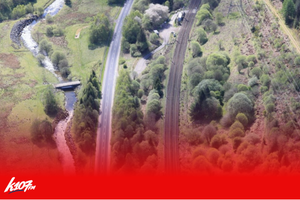
A pioneering study will investigate how climate change could create disruption across Scotland's critical infrastructure, helping organisations better understand risks to the services people depend on every day.
The research is being commissioned by the Climate Ready Infrastructure Scotland Forum (CRIS), a partnership of infrastructure operators, government bodies and academic institutions working to strengthen Scotland's resilience to climate change. It'll examine how problems affecting one infrastructure network can trigger much wider impacts elsewhere.
Believed to be one of the first studies of its kind in the world jointly commissioned by multiple infrastructure owners and operators, it’ll assess how climate-related disruption could spread across industries including transport, energy, water supply and communications. It’ll help identify vulnerabilities that might otherwise be missed when risks to sectors are considered separately.
Gillian Martin MSP, cabinet secretary for climate action and rural affairs, said:
“Our changing climate is placing increasing pressure on the infrastructure and services we rely on every day. As extreme weather becomes more frequent and severe, it is vital we understand not only the risks facing individual sectors, but also its knock-on effect.
“We’re committed to strengthening Scotland's infrastructure in the face of a changing climate and this pioneering project helps demonstrate Scotland's leadership on climate adaptation and resilience. By building a shared understanding of climate risks across transport, energy, water, communications and other critical networks, we will be in a better position to help identify interdependencies and ensure investment is targeted to maximise improvements to system-wide resilience.”
The study will create the first shared ‘register’ of how Scotland's infrastructure systems depend on one another. It’ll identify vulnerable points in the complex system-of-systems where climate-related failures could have the greatest consequences and analyse how climate-related disruption can spread across interconnected networks.
The commission will then look to bring the outputs to life through a series of place-based case studies across Scotland, simulating what these potential climate risks could mean for communities, businesses and essential services.
David Harkin, Network Rail Scotland’s weather resilience and climate change adaptation strategy manager and co-chair of the CRIS forum said:
"We have a growing understanding of the climate risks facing individual sectors, including within the railway. What's much less clear is how disruption can spread between them. A power outage can affect communications, transport disruption can delay recovery efforts, and the impacts can quickly reach far beyond the point where the original damage occurred.
“Much of our infrastructure was built for a climate that no longer exists. That’s why the Climate Ready Infrastructure Scotland Forum was created, and for the first time, organisations that own and operate our critical infrastructure are working together to build a shared understanding of these risks. The research will underpin everything we do next together to help build Scotland’s resilience to the changing climate.”
The study is being funded by a coalition of infrastructure owners, operators and public bodies from across Scotland, with support from the Scottish Government. Partners include Network Rail, Scottish Water, ScotRail, Openreach, SSEN Distribution and Transmission, Transport Scotland and the Met Office.
The National Centre for Resilience, hosted by the University of Glasgow, will manage the process and coordinate delivery on behalf of the funding partners.
Fabrice Renaud, professor of environmental risk and community resilience and director of the national centre for resilience at the school of social and environmental sustainability, University of Glasgow, said:
“The National Centre for Resilience is delighted to be delivering this Commission on behalf of the CRIS Forum. As Scotland faces increasing climate-related hazards, we need to better understand how our infrastructure systems are connected and how disruption in one sector could affect others.
“The Climate Risk Interdependencies Commission will look across sectors to identify where these interconnected vulnerabilities and risks lie, and what this could mean for our communities and the provision of essential services we all rely on. This work will help inform how we can strengthen Scotland's resilience to natural hazards and better prepare for the challenges we face.”
The project will now go out to tender through Public Contracts Scotland, with the successful supplier appointed to deliver the research over the next 12 months.
 Be The Early Bird
 Fybre Twist creating a twisted future
 Free Friday Night Football at Beacon Leisure Centre
 Hundreds come together for Fife Funders’ Fayre 2026
 Thornton’s Open for Business: Campaign urges people to support community during bridge works